
The Complete Essaouira Travel Guide: Wind, Ramparts, and Bohemian Soul on Morocco’s Atlantic Coast
Quick Facts: Essaouira at a Glance Feature Essential Details &…
Quick Facts: Essaouira at a Glance
| Feature | Essential Details & Verified Rates | Primary Source |
| UNESCO Status | Designated a UNESCO World Heritage Site in 2001 as an 18th-century fortified port (Medina of Essaouira, formerly Mogador) | World Heritage Explorer |
| Nickname & Wind | “Wind City of Africa” (Alizés trade winds); calmest weather in April–June and September–October | Morocco Escape Essaouira Guide |
| Sea Ramparts | Skala de la Kasbah (Northern ramparts): Free entry; Skala du Port (Harbor bastion): 60 MAD foreign adults (30 MAD residents) | Nomado Travel Ramparts Guide |
| Getting There | 3-hour coach ride from Marrakech via Supratours or CTM (90–125 MAD), or 2.5–3 hours north of Agadir along the coastal N1 | My Free Range Family Transport Guide |
| Signature Festival | Gnaoua and World Music Festival held annually in late June across outdoor stages at Place Moulay Hassan and the beach | Explore Essaouira Festival Guide |
| Daily Budget | Around 400–800 MAD/day for mid-range riad stays and fresh harbor seafood meals | Morocco Escape Essaouira Guide |
Introduction: Where Marrakech’s Heat Melts Into Atlantic Spray
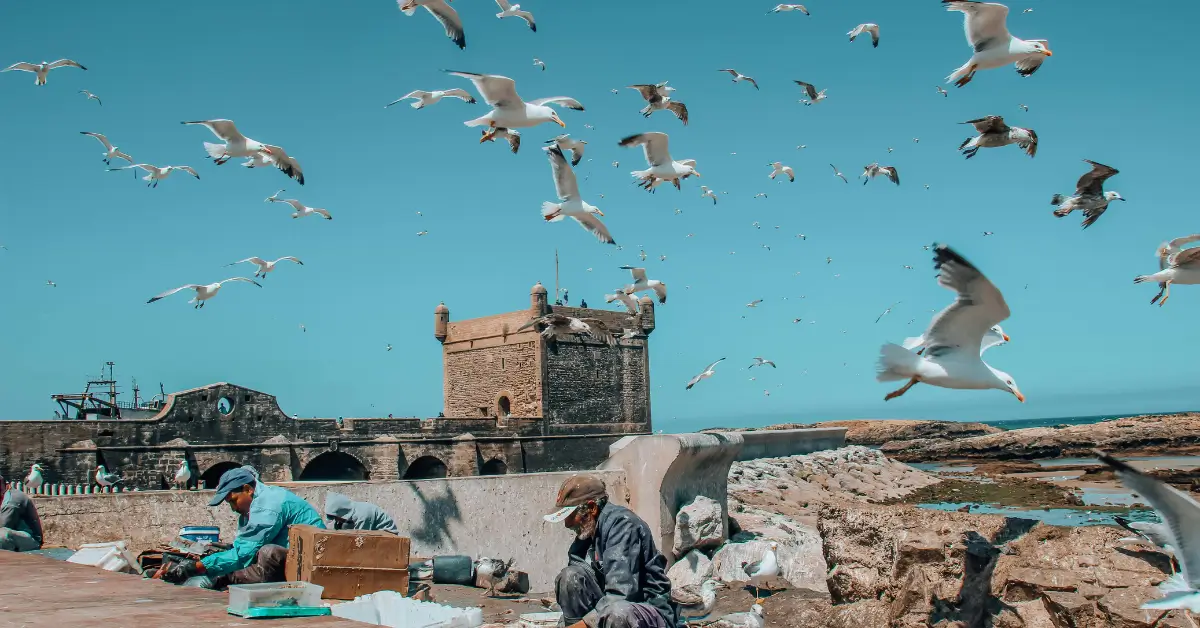
Step off the coach from Marrakech at the gates of Essaouira and the first thing that hits you isn’t a tout asking you to look at his carpet shop—it’s the salt-laced Atlantic wind and the shrill cry of yellow-legged gulls wheeling above 18th-century stone battlements (Morocco Escape Essaouira Guide).
For decades, travelers have treated Essaouira (historically known to Portuguese and European sailors as Mogador) as a quick day-trip escape from Marrakech’s terracotta heat. That’s a mistake. Once the afternoon tour buses pull out around 4:30 PM, the whitewashed alleys of this UNESCO-listed medina settle into a slow, hypnotic rhythm powered by Gnaoua bass lutes, the cedar-like scent of carved thuya wood, and wood-fired sardine grills down by the docks (Nomado Travel Thuya Guide).
I’m Adam, and in this guide for The Travel Vistas, I’ll show you why Essaouira deserves at least two or three nights on your Morocco itinerary—including how to tell its two famous cannon ramparts apart, how to order seafood at the port without overpaying, and where to chase waves along the wild southern dunes.
Why Essaouira’s Medina Doesn’t Feel Like Any Other in Morocco
If you’ve ever gotten hopelessly lost in the dead-end derbs of Fes el-Bali, you’ll notice something unusual within five minutes of walking into Essaouira: the streets run in straight, intersecting lines (Journey Beyond Travel UNESCO Guide).
In 1760, the Alaouite Sultan Sidi Mohammed ben Abdallah decided to build a fortified royal port that would open Morocco to transatlantic and European trade (Nomado Travel Skala Guide). He hired French military engineer Théodore Cornut—a disciple of Vauban’s coastal fortification style—alongside English and Moroccan master builders (Apsaidal Medina of Essaouira, Journey Beyond Travel UNESCO Guide).
The result, inscribed as a UNESCO World Heritage Site in 2001, is a one-of-a-kind marriage of European Enlightenment town planning and Moroccan-Andalusian architecture. Wide, colonnaded avenues like Avenue de l’Istiqlal and Rue Mohamed El Qorry slice cleanly from the landward gates to the sea, flanked by white houses with cobalt-blue shutters. In Arabic, Es-Saouira translates to “The Beautifully Designed”—a name that still fits every corner of the old town.
8 Essential Experiences in Essaouira
1. Walk Both Sea Bastions: Skala de la Kasbah vs. Skala du Port
First-time visitors often confuse Essaouira’s two fortified sea ramparts, yet they sit at opposite ends of the waterfront and offer completely different perspectives (Nomado Travel Skala du Port):
- Skala de la Kasbah (Skala de la Ville): Located along the northwestern edge of the medina, this elevated 200-meter stone promenade is lined with 18th-century Spanish and European bronze cannons aimed out at the crashing Atlantic waves (Nomado Travel Skala de la Kasbah). Orson Welles filmed the opening scenes of Othello (1952) here, and Game of Thrones fans will recognize it instantly as Astapor. Entry is completely free, and it is the undisputed best spot in town for sunset (Morocco Escape Essaouira Guide).
- Skala du Port: Positioned right inside the working fishing harbor beyond the monumental Bab el-Marsa (Marine Gate), this two-winged bastion is crowned by the crenelated Borj el-Barmil tower (Nomado Travel Skala du Port). Climbing up gives you that iconic postcard view looking back across dozens of cobalt-blue wooden fishing boats toward the medina walls. Entry costs 60 MAD for foreign adults (30 MAD for Moroccan residents; 25 MAD for children) (MaJourneys Port Guide, Nomado Travel Skala du Port).
2. Experience the Morning Auction at the Fishing Port
Beyond the ticketed rampart, the working Port of Essaouira is free to wander at any hour (MaJourneys Port Guide). Arrive between 9:30 AM and 11:30 AM when the wooden trawlers and small blue chaloupes return with the morning catch—crates of glittering sardines, spider crabs, conger eels, and Atlantic sole (Visit Essaouira Port Guide).
Right beside the docks, traditional shipwrights still hand-shape massive wooden hulls using adzes and steam-bent planks—one of the last active wooden boatyards in the Mediterranean and Atlantic basin (MaJourneys Port Guide).
3. Follow Your Nose to the Thuya Wood Workshops
Tucked literally inside the vaulted casemates beneath the northern Skala ramparts is the carpenters’ souk, where master artisans (maâlems) work with Thuya wood (Tetraclinis articulata), a coniferous tree endemic to the Atlas foothills around Essaouira (Craft Heritage Thuya Marquetry, Marokkanisch Thuya Guide).
The prized part of the tree is the subterranean root burl (loupe de thuya), which displays swirling,bird’s-eye grain patterns in shades of mahogany and amber and releases a rich, resinous aroma that never fades (Unveiling Morocco Thuya Craft). Watching artisans inlay thuya boxes, chessboards, and tables with lemonwood, ebony, and mother-of-pearl is completely free, and buying directly from the workshop benches costs a fraction of export gallery prices (Nomado Travel Thuya Guide).
4. Visit Bayt Dakira & The Historic Mellah
In the 19th century, under Sultan Mohammed ben Abdallah’s ”Tujjar as-Sultan“ (Royal Merchants) policy, Jewish families made up nearly 40% of Mogador’s population, handling international trade with London, Marseille, and Livorno (Gateway2Morocco Jewish Essaouira).
Today, in the heart of the old Mellah (Jewish Quarter) in the northeastern medina, you can visit Bayt Dakira (“House of Memory”). Inaugurated in January 2020 around the beautifully restored 19th-century Simon Attias Synagogue, this museum and research center celebrates centuries of Judeo-Muslim coexistence through family photographs, Torah scrolls, silver ritual objects, and musical archives (Fortrip Bayt Dakira Guide, GetYourGuide Bayt Dakira).
- Practical Details: Located on Rue Ziry Ibn Atiyah; open daily from 9:00 AM to 7:30 PM (Fortrip Bayt Dakira Guide). Pair it with a quiet walk past the nearby Chaim Pinto Synagogue (Shin Tours Jewish History).
5. Immerse Yourself in Gnaoua Music & Local Art Galleries
Essaouira is the spiritual home of Gnaoua music—an ancient, trance-inducing tradition brought north across the Sahara by West African communities, blending hypnotic three-stringed guembri bass lines with the clatter of heavy iron castanets (qraqeb) and call-and-response chanting (Wikipedia Gnawa Festival).
Every late June, the city hosts the legendary Gnaoua and World Music Festival (founded in 1998), drawing hundreds of thousands of music lovers for free open-air fusion concerts on Place Moulay Hassan and the main beach (Morocco Escape Gnaoua Guide, JamBase Festival Guide). Even outside festival week, you can hear live Gnaoua sessions nightly in medina cafés and browse Gnaoua-inspired Outsider art at Galerie d’Art Damgaard near Bab Marrakech (free entry, open daily 9:00 AM – 1:00 PM and 3:00 PM – 7:00 PM). (Note: If you plan to visit the ethnographic Sidi Mohammed Ben Abdallah Museum on Rue Laalouj, check locally at the door first, as it has undergone extended rehabilitation closures).
6. Kitesurf the Bay or Walk to Diabat & Borj El Berod
Thanks to the steady Alizés trade winds that blow down the Atlantic coast from spring through autumn, Essaouira Bay is one of North Africa’s premier playgrounds for windsurfing, kitesurfing, and wing-foiling (Morocco Escape Essaouira Guide). The wide, shallow crescent protects learners near the shore while offering strong cross-shore wind further out.
At low tide, walk 45 minutes south along the wet sand past the Oued Ksob river mouth to see the half-buried stone ruins of Borj El Berod, a crumbling 18th-century watchtower rising out of the dunes. Just inland lies the village of Diabat, famous in local lore for the late-1960s hippie era and camel treks through the coastal eucalyptus forests.
7. Take a Surf Day Trip to Sidi Kaouki
If the medina beach feels too breezy or busy, hop in a local taxi for a 27-kilometer (30-minute) drive south to the wild surf village of Sidi Kaouki. Anchored by the whitewashed marabout shrine of Sidi Kaouki right above the high-tide line, this vast, untamed beach offers punchier beach-break waves for surfers, rustic beachfront fish shacks, and miles of empty sand (Daytrips Sidi Kaouki Guide).
- Getting There: A shared grand taxi from outside Bab Doukkala in Essaouira costs just a few dozen dirhams per seat (around 50–65 MAD for local taxi hops), or you can book a private round-trip transfer for around €20–€28 (Rome2Rio Sidi Kaouki, CAB Morocco Taxi, Bacharide Transfer).
8. Watch the Sunset From Place Moulay Hassan & Rooftop Terraces
As late afternoon cools the medina, life gravitates toward Place Moulay Hassan, the wide, breezy plaza linking the souks, the port, and the ocean (MaJourneys Essaouira Medina). Claim a rooftop table overlooking the square or the western ramparts, order a glass of fresh mint tea or a local grey wine (vin gris) from the nearby Val d’Argan vineyards in Ounagha, and watch the Atlantic sky shift from apricot to deep indigo behind the Mogador islands.
Where & How to Eat Fresh Seafood in Essaouira Like a Local
When it comes to eating fish in Essaouira, you have two distinct experiences depending on your mood (Visit Essaouira Port Guide):
- The Open-Air Port Stalls (Outside Bab el-Marsa): Just outside the harbor gate stands a row of numbered blue-and-white wooden grill stalls displaying raw fish on ice. While atmospheric, the stalls closest to the entrance can be pushy. Insider strategy: Walk past the first few stalls, ask for the weight price per kilo before anyone puts fish on the scale, and double-check whether bread, salad, and olives are included in the quoted price (a fair lunch for two with grilled sardines, calamari, and a whole sea bream typically runs 150–250 MAD total).
- The Inside-the-Harbor Fish Market Grill: For a more authentic, zero-hassle experience, walk inside the fishing port to the concrete fish hall, buy your raw shrimp, sardines, or red snapper directly from the fishmongers by weight for a few dirhams, and hand them to the tiny charcoal grill shacks next door, who will grill your feast to order and serve it with tomato salad and lemon for a small cooking fee (Visit Essaouira Port Guide).
Suggested 3-Day Slow-Travel Essaouira Itinerary
- Day 1: The Ramparts, The Port & The Medina Grid
- Morning arrival and coffee on Place Moulay Hassan (MaJourneys Essaouira Medina).
- Late morning exploration of the working fishing harbor and a climb up the Skala du Port tower.
- Fresh charcoal-grilled seafood lunch by the docks (Visit Essaouira Port Guide).
- Afternoon stroll through the Thuya wood workshops and sunset along the cannons of Skala de la Kasbah.
- Day 2: Hidden History, Art & The Southern Dunes
- Morning visit to Bayt Dakira and the historic lanes of the Mellah.
- Midday stop at Galerie d’Art Damgaard and spice shopping at the central Marché aux Grains.
- Afternoon beach walk south toward the ruins of Borj El Berod or a 2-hour beginner kitesurf lesson on the bay.
- Day 3: Wild Coast Escape to Sidi Kaouki & Argan Country
- Morning excursion south to Sidi Kaouki for surfing, beachcombing, and a lazy seaside tagine lunch.
- Afternoon stop at a women-run Argan oil cooperative along the coastal road on your way back to Essaouira or onward south toward Agadir.
Frequently Asked Questions
How do I get from Marrakech to Essaouira by bus?
The easiest, most reliable way is by intercity coach, which takes around 3 hours across the Haouz plain and Argan groves (Morocco-Tips Bus Guide):
- Supratours: Runs roughly 6 daily departures from its station right next to the Marrakech ONCF train station, dropping you immediately outside Essaouira’s medina wall at Bab Marrakech (tickets cost 95 to 125 MAD, plus ~5 MAD for checked luggage) (My Free Range Family Transport Guide).
- CTM: Offers comfortable daily coaches for around 90 to 100 MAD, arriving at the CTM station a short 15-minute walk or 10 MAD petit taxi ride from the medina gates (Marrakech Tickets Bus Guide). Book your seat a day in advance during peak season.
Is Essaouira too windy for a beach holiday?
Essaouira is famous for its Alizés trade winds, especially in July and August when strong gusts make it a paradise for kitesurfers and a cool 24°C refuge from Marrakech’s 40°C heat—though blowing sand can make sunbathing tricky on peak wind days (Morocco Escape Essaouira Guide). For the calmest breezes and warmest beach-lounging weather, visit in April–June or September–October (Morocco Escape Essaouira Guide).
Should I visit Essaouira as a day trip or stay overnight?
While you can technically see the port and ramparts on a 10-hour round-trip day tour from Marrakech, staying 2 to 3 nights inside a traditional medina riad is infinitely more rewarding (Morocco Escape Essaouira Guide). Early mornings and evenings—when day-trippers are gone and the mist rolls over the ramparts—are when Essaouira’s bohemian magic truly comes alive.
How can I travel between Essaouira and Agadir?
Essaouira and Agadir sit roughly 175 km apart along the scenic Atlantic N1 coastal highway (Morocco Escape Essaouira Guide). Direct Supratours and CTM coaches connect the two cities in about 3 to 3.5 hours, or you can rent a car / hire a private transfer (around 2.5 to 3 hours) to stop along the way at the cliffside surf bay of Imsouane and the waves of Taghazout.