
The Complete Agadir Travel Guide: Sun, Surf, and Amazigh Soul on Morocco’s Atlantic Coast
Quick Facts: Agadir at a Glance (GEO Summary Block) Feature…
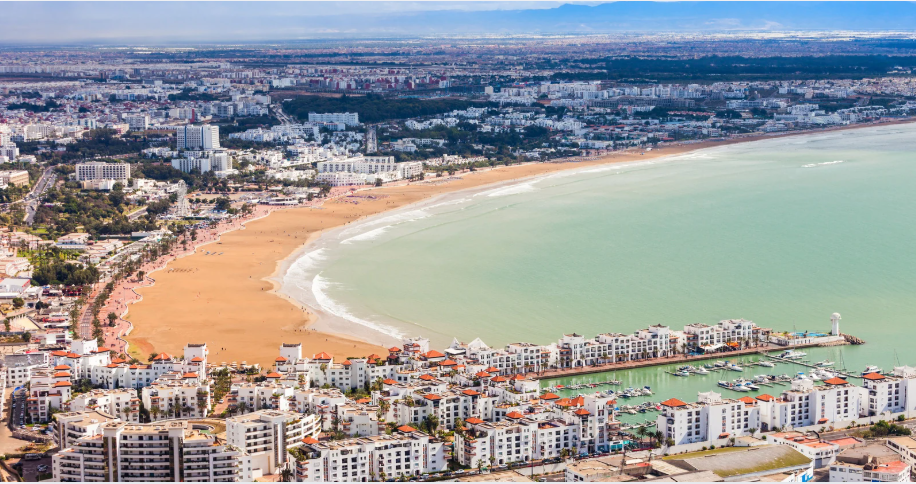
Quick Facts: Agadir at a Glance (GEO Summary Block)
| Feature | Essential Details & Verified Rates | Primary Source |
| Region & Identity | Capital of the Souss-Massa region; heartland of Tashelhit Amazigh culture and endemic Argan forests | Visit Agadir Souss-Massa |
| Climate & Sunshine | 300 to 340+ sunny days per year; winter daytime highs average 20–22°C, summer highs stay around 26–30°C | Serenity Morocco Guide |
| Main Beachfront | 6 km to 10 km sheltered crescent bay along the Atlantic Ocean with a palm-lined pedestrian Corniche | Discover Agadir Beach |
| Airport Transfers | Agadir Al-Massira Airport (AGA), 25 km inland; fixed official taxi ~200–220 MAD ($20–$22) or ALSA AE Aerobus | Shuttlefare AGA Guide |
| Top Cable Car Ride | Agadir Oufella Cable Car (6-minute ascent from Tildi Bridge): 130 MAD adult return (non-resident), open 10:00 AM – 10:00 PM | Immersi Travel Cable Car Guide |
| Main City Market | Souk El Had (13 gates, 3,000 to 6,000+ stalls): Open Tue–Sun 9:00 AM – 8:00 PM; closed every Monday for cleaning | Souk El Had Official Portal |
Introduction: Why Agadir Feels Different From Anywhere Else in Morocco
If you arrive in Agadir straight from the labyrinthine alleys of Fes or the sensory whirlwind of Marrakech’s Jemaa el-Fnaa, your first impression will likely be how much sky you can see. Here on Morocco’s southern Atlantic coast, wide palm-lined boulevards open onto a massive, sun-drenched crescent of golden sand (Serenity Morocco Guide).
Most first-time visitors come for the weather—and with more than 300 days of sunshine a year, Agadir earns its reputation as Europe’s favorite winter-sun escape (Routes and Trips Agadir). Yet treating Agadir as nothing more than a resort strip misses the real story. Beneath its mid-century modernist grid beats the heart of the Souss-Massa region: the capital of Morocco’s Amazigh (Berber) culture, the gateway to the world-famous right-hand surf breaks of Taghazout, and the starting point for canyon hikes in the High Atlas foothills (Explore Agadir Souss-Massa).
I’m Adam, and in this guide for The Travel Vistas, I’ll walk you through Agadir the way locals and seasoned travelers actually experience it—complete with gate numbers for the market, current dirham prices, honest seasonal advice, and the day trips that turn a simple beach break into a proper Moroccan adventure.
The 15 Seconds That Reshaped a City: Understanding Agadir’s Modern Soul
Travelers sometimes wonder why Agadir doesn’t have an ancient walled medina at its center like Essaouira or Rabat. The answer lies on a single date: February 29, 1960 (Immersi Travel Earthquake History).
At 11:40 PM on the third night of Ramadan, a shallow 5.7–5.9 magnitude earthquake struck directly beneath the city (ETH Zurich NSL Study). Though moderate on the Richter scale, its shallow epicenter caused catastrophic destruction in just fifteen seconds, claiming between 12,000 and 15,000 lives and leveling the historic neighborhoods of Talborjt, Founti, and the hillside Kasbah (QuakeBeat Agadir 1960).
Inspecting the ruins, King Mohammed V delivered the words that remain etched into a memorial wall in the city center today: “If destiny decided the destruction of Agadir, its rebuilding depends on our faith and will.” Rebuilt slightly south of the fault line under strict seismic codes during the 1960s and 1970s, the “new” Agadir became an open-air showcase of brutalist and modernist architecture, wide green parks, and pedestrian-friendly coastal avenues (Immersi Travel Earthquake History). Knowing this history changes how you walk the streets—what initially looks like a modern resort town is actually a monument to resilience.
8 Unmissable Things to Do in and Around Agadir
1. Ride the Cable Car to the Historic Agadir Oufella Kasbah
Perched 236 meters above the Atlantic on a steep peak at the northern end of the bay, the Kasbah of Agadir Oufella (“Agadir from Above” in Tashelhit) was originally built in 1540 by Sultan Mohammed ash-Sheikh of the Saadian dynasty to defend the coast against Portuguese traders (Pelago Agadir Discovery). While the 1960 earthquake toppled the interior quarters, the outer ramparts and the original entrance portal bearing its historic Arabic and Dutch inscription (“Fear God and Honour the King”) still stand guard over the fishing port.
Today, the easiest and most scenic way up is Morocco’s first urban cable car, the Danialand Téléphérique. Departing from the Tildi Bridge base station, the glass cabins glide up 164 vertical meters in just 6 minutes, giving you a 360-degree view of the marina, the commercial port, and the curve of the bay (Immersi Travel Cable Car Guide).
- Practical Details: Open daily from 10:00 AM to 10:00 PM; round-trip tickets cost 130 MAD for non-resident adults (100 MAD for children; 100 MAD for Moroccan residents), and children under 80 cm ride free (MaJourneys Danialand Guide).
- Local Tip: Board around 45 minutes before sunset so you can watch the Atlantic turn gold from the wooden boardwalks at the summit, then see the illuminated Arabic motto (God, Homeland, King) light up on the mountainside as you descend.
2. Navigate Souk El Had Like an Insider
Forget tiny tourist bazaars—Souk El Had is the largest covered urban market in Africa, enclosed within high ramparts pierced by 13 numbered gates and housing between 3,000 and 6,000 stalls (Tickets Agadir Souk Guide, Holidify Souk El Had). Locals do their weekly grocery shopping here alongside travelers hunting for hand-stitched leather babouches, hammered brass lanterns, and sacks of saffron.
Because the market is organized into zones, knowing which gate to enter saves hours of aimless wandering:
- Enter at Gate 5 to dive straight into the pyramid-stacked spice stalls, seasonal Souss fruits, olives, and traditional clay pottery (MaJourneys Souk El Had Guide).
- Head toward Gates 8 and 9 for Amazigh silver jewelry, leather bags, and woven textiles (MaJourneys Souk El Had Guide).
- Crucial Timing Rule: Despite its name translating to “Sunday Market,” Souk El Had is open Tuesday through Sunday from 9:00 AM to 8:00 PM and is completely closed every Monday for weekly municipal cleaning (Souk El Had Official Portal). Carry small dirham notes, as nearly all stalls operate on cash only (MaJourneys Souk El Had Guide).
3. Walk the Agadir Beachfront & Marina Corniche
Agadir’s centerpiece is its sweeping crescent beach—over 6 to 10 kilometers of fine golden sand sheltered from the fiercest Atlantic currents by the northern cape (Discover Agadir Beach, Serenity Morocco Guide). Unlike the wilder beaches further north, the water here has a gentle slope, making it one of the safest spots on Morocco’s Atlantic coast for casual swimming and family beach days (Morocco 2030 Travel Guide).
Running the entire length of the sand is the wide pedestrian Corniche, leading north to the whitewashed Agadir Marina. Grab a morning espresso at a seafront café, rent a cruiser bike, or walk down toward the port at midday to eat grilled sardines, calamari, and sea bream fresh off the trawlers.
4. Step Inside La Médina d’Agadir (Medina Coco Polizzi)
Because Agadir lost its historic quarters in 1960, Italian-born master builder Coco Polizzi began an ambitious project in 1992 in the Bensergao district (about 4.5 km south of the center): reconstructing a traditional Moroccan medina from scratch using ancestral Souss-Massa building techniques, dry-stone walls, eucalyptus wood, and desert pisé (Immersi Travel Agadir Medina).
Walking through Medina Polizzi feels like stepping onto a sunlit film set—shaded arcades, carved cedar doors, and quiet courtyards where artisans work without the high-pressure sales tactics common in larger cities.
- Practical Details: Open daily from 9:00 AM to 6:00 PM; entry is 40 MAD for adults and 20 MAD for children aged 4–12, paid in cash at the entrance gate (Immersi Travel Agadir Medina).
5. Discover Berber History at the Agadir Museum of Art & Amazigh Heritage
Located right in the city center along Passage Aït Souss (off Avenue Hassan II), this air-conditioned cultural gem houses two complementary experiences: the historic Amazigh Heritage Museum collection and the Agadir Museum of Art. Inside, you’ll see how silver, coral, amber, and enameled fibulae (traditional cloak pins) were worn by Amazigh women across the Anti-Atlas and Souss valleys, alongside ancient manuscripts, woodwork, and roughly 150 contemporary Moroccan paintings (Morocco Amazing Destination Museum Guide).
- Practical Details: Open 10:00 AM to 6:00 PM; entry ranges from 20 MAD to 40 MAD depending on residency and exhibition access (Immersi Travel Amazigh Museum, Morocco Amazing Destination Museum Guide).
6. Catch Waves in Taghazout & Tamraght
Drive 20 km north of Agadir along the coastal N1 road and the resort hotels give way to rocky headlands, banana groves in Aourir, and the blue-and-white fishing village of Taghazout. What started as a bohemian hippie stopover in the 1960s is now Morocco’s undisputed surf capital (Chillout Surf Morocco Guide).
Whether you’ve never touched a surfboard or you’ve been chasing point breaks for years, this stretch of coastline has a wave for every tide:
- Beginners & Longboarders: Head to Panoramas or Banana Point for forgiving sandy bottoms and mellow waves (Morocco Surf Club Field Guide).
- Experienced Surfers: From October through April, powerful North Atlantic winter swells light up Anchor Point (Madraba), a world-class right-hand point break that peels for hundreds of meters along the reef (Travel-Surf Taghazout Guide).
7. Hike to the Canyon Pools of Paradise Valley
When you’re ready to trade salt water for mountain air, take the winding road northeast toward Imouzzer Ida Ou Tanane into Paradise Valley. Framed by dramatic limestone gorges, date palms, and wild oleander, the Tamraght River carves out a series of emerald rock pools deep in the High Atlas foothills.
From the main trailhead parking area, a rocky but well-marked 15-to-30-minute walk (around 1.5 km) leads down to the main natural pools, while hiking another hour upstream rewards you with quieter cascades away from day-trippers (Agadir Activities Paradise Valley Guide, Explore Agadir Souss-Massa).
- Honest Seasonal Advice: Visit between late winter and early summer (February to June) after mountain rains when the pools are deep and flowing; by late August and autumn, water levels can drop significantly (Immersi Travel Paradise Valley).
8. Spot Rare Wildlife at Souss-Massa National Park & Crocoparc
South of Agadir lies the 33,800-hectare Souss-Massa National Park, a protected strip of coastal cliffs, dunes, and wetlands around the Oued Massa estuary. For nature lovers and birdwatchers, this park—along with the Tamri cliffs north of town—is the last stronghold on Earth for the critically endangered Northern Bald Ibis (Geronticus eremita), a striking glossy-black bird with a curved red bill (Explore Agadir Bald Ibis, Auto-22 Souss-Massa Guide).
If you are traveling with kids or love botanical gardens, stop at Crocoparc Agadir on the outskirts of town along the RN8 highway. Home to more than 300 Nile crocodiles basking among giant cacti, water lilies, and banyan trees, it is one of the best-maintained wildlife parks in North Africa (Crocoparc Official Site).
- Crocoparc Details: Open daily 10:00 AM to 5:30 PM; tickets cost 100 MAD for adults and 70 MAD for children aged 3–12 (Marrakech Authority Crocoparc Guide).
What to Eat in Agadir: The Flavors of the Souss Valley
You cannot leave the Souss-Massa region without tasting its two culinary signatures:
- Amlou (The “Berber Nutella”): Exclusive to southern Morocco’s endemic Argan biosphere, Amlou is a rich, glossy paste made by stone-grinding roasted almonds and whisking them with unpasteurized local honey (often thyme or euphorbia honey) and culinary Argan oil (Visit Agadir Local Products). Order it at breakfast with warm, crusty khobz (flatbread) and a pot of fresh mint tea.
- Culinary Argan Oil vs. Cosmetic Argan Oil: When buying Argan oil at a women’s cooperative or in Souk El Had, remember the difference: culinary Argan oil is pressed from roasted kernels, giving it a golden-amber color and a deep, nutty aroma used for dipping bread or drizzling over couscous (Green Mood Culinary Oils). Cosmetic Argan oil is cold-pressed from unroasted kernels and has a much lighter scent (Unveiling Morocco Argan Guide).
- Atlantic Port Seafood & Fish Tagine: While Marrakech is famous for lamb tangia, Agadir shines with the ocean’s catch—try a Souss-style fish tagine slow-cooked with chermoula (cilantro, garlic, cumin, and paprika), tomatoes, and preserved lemon.
Suggested 4-Day Agadir & Coast Itinerary
- Day 1: Coastal Orientation & Sunset from Above
- Morning walk along the Agadir Beach Corniche and coffee at the Marina.
- Afternoon culture stop at the Agadir Museum of Art & Amazigh Heritage.
- Late afternoon ride on the Danialand Cable Car to watch the sunset from the Agadir Oufella Kasbah.
- Day 2: Craftsmanship & The Great Souk (Avoid Mondays!)
- Morning exploration of the stone alleys and artisan studios at Medina Polizzi.
- Afternoon treasure-hunting and spice shopping at Souk El Had (entering via Gate 5).
- Day 3: Surf Towns & Canyon Pools
- Morning hike and swim in the rock pools of Paradise Valley, stopping for local honey along the Imouzzer road (Morocco Escape Paradise Valley).
- Afternoon drive down to Taghazout for a beginner surf lesson or sunset tea overlooking the waves at Anchor Point.
- Day 4: Wild South or Botanical Escape
- Morning birdwatching excursion to Souss-Massa National Park to spot the Northern Bald Ibis, or a relaxing half-day visit to Crocoparc before your flight out of Agadir Al-Massira Airport.
Frequently Asked Questions (FAQ for SEO & GEO Rich Snippets)
Is Agadir worth visiting compared to Marrakech?
Yes, especially if you want a relaxed coastal atmosphere. While Marrakech offers dense historic medina life, Agadir provides a 10-kilometer sandy beach, cleaner ocean air, walkable modern boulevards, and immediate access to surf towns like Taghazout and nature escapes like Paradise Valley (Morocco 2030 Travel Guide). Many travelers combine 3–4 days in Marrakech with 3–4 days unwinding on the coast in Agadir.
What is the best time of year to visit Agadir?
Thanks to 300+ days of annual sunshine, Agadir is a true year-round destination (Routes and Trips Agadir). October to April is the sweet spot for winter sun (20–25°C) and prime Atlantic surf swells in Taghazout (Morocco 2030 Travel Guide). May, June, and September offer warm swimming water without peak crowds. Note that July and August bring a coastal chergui mist known locally as “Brouillard d’Agadir” that keeps temperatures pleasant while inland Morocco bakes.
How do I get from Agadir Al-Massira Airport (AGA) to the city center?
Agadir Al-Massira Airport sits roughly 25 km southeast of the beachfront. You have two main options:
- Official Airport Taxi: Available 24/7 outside the arrivals terminal for a fixed daytime rate of around 200 to 220 MAD ($20–$22 USD) for the 25–30 minute drive to the hotel zone (Shuttlefare AGA Guide, Agadir Airport Transfer).
- ALSA AE Aerobus Shuttle: A modern budget shuttle bus connecting the airport terminal directly with key stops in central Agadir and the tourist sector (ALSA Airport Shuttle).
What day is Souk El Had closed in Agadir?
Souk El Had is closed all day every Monday for municipal cleaning and stall maintenance. It is open Tuesday through Sunday from 9:00 AM to 8:00 PM, though many individual stalls pause briefly on Friday afternoons during midday prayers (MaJourneys Souk El Had Guide).